
2017 Critical Perspectives on Accounting Conference
Date July 2 to 5, 2017
Time 9:00 a.m. to 5:00 p.m.
Location Pavillon Palasis-Prince
About the
Event

Québec City, Canada
Université Laval
Main Conference: July 3-5, 2017
Emerging Scholars Colloquium: July 2, 2017
The Faculty of Business Administration of Laval University (FSA ULaval) is very proud to host in July 2017 the Critical Perspectives on Accounting (CPA) Conference.
The CPA Conference is an established forum for critical, radical and other interdisciplinary approaches to the study of accounting phenomena. It brings together scholars in the fields of accounting, management and the broader social science disciplines who are concerned to illustrate how deeply implicated accounting is in the allocative, social, and ecological problems of our times. As well, it attracts practitioners, policy makers and activists who are interested in these pressing issues and committed to social change.
The CPA Conference will establish an inclusive and energizing atmosphere. All papers will receive a sympathetic and supportive double-blind review. A condition of paper submission is that, if accepted, the paper will be presented at the 2017 CPA Conference by one of the authors.
2020 CPA conference
We are pleased to announce that the 2020 Critical Perspectives on Accounting (CPA) Conference will be held at the Schulich School of Business, York University, Toronto, Canada. Like its sister conferences, the IPA and APIRA, the conference will be held in July so as to avoid most teaching scheduling conflicts. An emerging Scholar’s Colloquium will precede the main conference.
Program
- Program at a Glance
- Detailed Program
You received the password required to download the papers by e-mail on June 14, 2017.
Organizing and Scientific Committees
Conference Organizing Committee
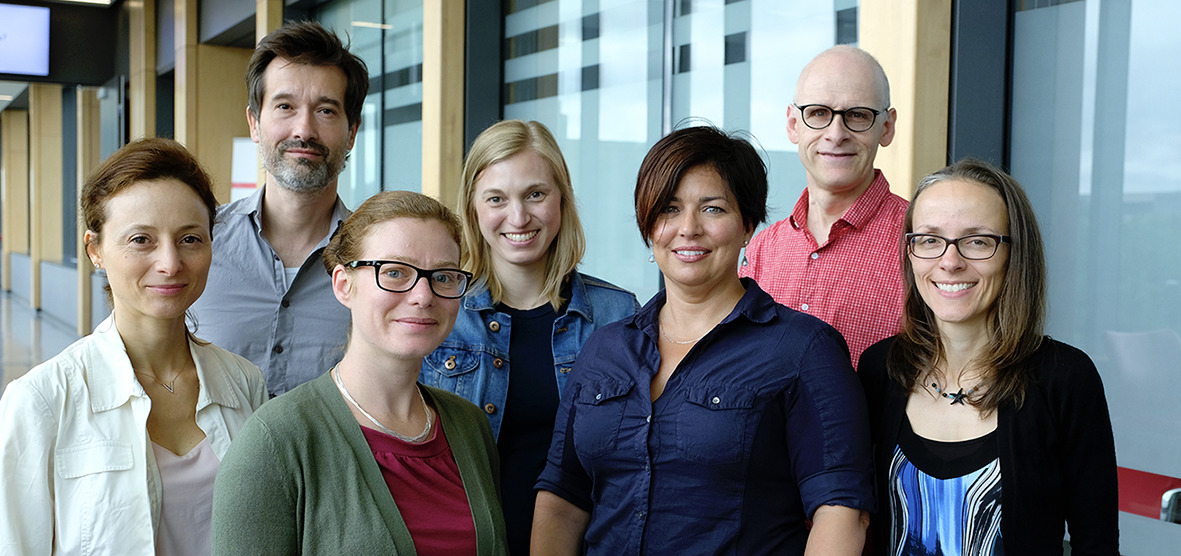
Chair
Yves Gendron
Organizing Committee Members
Céline Baud
Marion Brivot
Henri Guénin-Paracini
Claire-France Picard
Mélanie Roussy
Michelle Rodrigue
Emerging Scholars Colloquium Chair
Marion Brivot
Scientific Committee
Chair and Co-Chairs
Yves Gendron, Chair, Université Laval
Henri Guénin-Paracini, Co-Chair, Université Laval
Mélanie Roussy, Co-Chair, Université Laval
Scientific Committee Members
Céline Baud, Université Laval
Lisa Baudot, University of Central Florida
Marion Brivot, Université Laval
Laure Célérier, HEC Paris
Mohamed Chelli, Telfer School of Management, University of Ottawa
Charles Cho, ESSEC Business School
Cynthia Courtois, Université du Québec à Trois-Rivières
Claire Dambrin, ESCP Europe
Simon Dermarkar, HEC Montréal
Sylvain Durocher, Telfer School of Management, University of Ottawa
Claire Garnier, HEC Montréal
Delphine Gibassier, Toulouse Business School
Christine Gilbert, Université Laval
Claudine Grisard, Strathclyde Business School
Mouna Hazgui, HEC Montréal
Darlene Himick, Telfer School of Management, University of Ottawa
Lambert Jerman, HEC Montréal
Hervé Kohler, Université de la Polynésie Française
Caroline Lambert, HEC Montréal
Carlos Larrinaga, University of Burgos
Bertrand Malsch, Queen’s University
Afshin Meyrpouya, HEC Paris
Jérémy Morales, Royal Holloway, University of London
Claire-France Picard, Université Laval
Michelle Rodrigue, Université Laval
Ebba Sjögren, Stockholm School of Economics
Samuel Sponem, HEC Montréal
Sophie Tessier, HEC Montréal
Marie-Soleil Tremblay, École nationale d’administration publique
Call For Papers
Deadline for submission of full papers (main conference and ESC): February 10, 2017
The Critical Perspectives on Accounting Conference brings together accounting faculty, doctoral students and researchers from other disciplines who are interested in critical accounting research. The Conference is held every three years. It aims to build and consolidate the network of active supporters of critical accounting scholarship. The Conference also seeks to encourage critical reflexivity on the development of accounting prescriptions and the practice of accounting in a world facing a multitude of challenges. Further, the Conference aims to generate substantive conversations on how accounting might be improved in the hope of constructing a better and fairer world.
Research areas of interest to the Conference are as follows (this list is indicative and not exhaustive):
- Financial accounting’s role in the processes of international capital formation, including its impacton stock market stability and international banking activities
- Management accounting’s role in organizing the labor process
- The relationship between accounting and the state in various social formations
- Studies of accounting’s historical role, as a means of “remembering” the subject’s social and conflictual character
- The role (and consequences) of sustainability accounting in promoting discourses and images consistent with the claim of corporate social responsibility
- Studies aiming to question and deconstruct corporate governance discourses and practices
- The role of tax regulation and practices in engendering social inequities
- The power of the accounting establishment in promoting neoliberalism and financialization
- Accounting’s role in globalization processes
- Antagonisms between the social and private character of accounting
- Accounting’s role in gender, class, racial, and ethnic conflicts in the workplace and society
The CPA Conference aims to stimulate an inclusive and energizing atmosphere. All papers will be reviewed before being accepted to the Conference. A discussant will be assigned if the paper is accepted. By submitting a paper you agree that you, or one of your co-authors, a) may be asked to review a paper submitted to the Conference; b) will present your own paper during the Conference; and c) will discuss another paper during the Conference (note: “b” and “c” only apply to authors whose papers are accepted to the Conference).
Submission has been closed. Acceptance notification has been sent to the authors. The deadline to upload any revised version of accepted manuscripts on the submission system is May 1, 2017.
Paper Submission Instructions
- Full papers have to be submitted electronically via this website (please see the page “Online Paper Submission”).
- According to a policy stipulated by the Conference Organizing Committee, each individual is limited to two personal appearances on the programme as a presenting author. This policy precludes acceptance of papers for more than two presentations. As a result, an author can submit and present a maximum of two papers. This policy excludes papers submitted by an individual’s coauthors (for which the individual is not the presenting author).
- The official language of the CPA Conference is English. Therefore, full papers must be submitted and presented in English.
Online Submission System
Discussants
Please recall that the format of the 2017 CPA Conference implies that one discussant is assigned to each paper being presented. You are kindly asked to be one of our discussants. In order to download the paper(s) that you have been assigned to discuss, please go through the following steps:
- Go to the Online Submission System.
- Click on the green rectangle entitled “Sign in”.
- In order to sign in, use the same username and password you used to submit your own manuscript(s).
- If you do not remember them, click on “lost credentials” (just below the green rectangle entitled “Sign in”).
- If you encounter any problem, please contact us; we will put you in touch with our IT department.
For your convenience, please find attached the preliminary program of the Conference. The final version of this program will be available on the Conference website in a few weeks.
Also, we invite you to consider the following:
- Please ensure that your discussion is conducted with the aim of providing constructive feedback to the authors.
- Your discussant comments will immediately follow the author’s presentation of the paper.
- You will have 10 minutes to present your comments.
- If you feel comfortable in doing this, then you are welcome to send your comments by email directly to the author a few days before the Conference.
- Please arrive at your session room at least 10 minutes prior to the start of the session. This will give you the opportunity to introduce yourself to the author(s) of the paper you will discuss and to upload on the room’s computer any file you would like to use when presenting your comments.
- Roaming audiovisual technicians will be onsite to assist you in addressing any technical problem encountered. Presentations must be provided on a USB (memory stick), with the file in a PowerPoint PC format.
Thank you once again for your contribution to the success of 2017 CPA Conference!
Authors
Submission has been closed. Acceptance notification has been sent to the authors. The deadline to upload any revised version of accepted manuscripts was May 1, 2017.
Registration & Fees
Conference registration fees (Canadian dollars):
- Early bird registration fee (deadline: May 1st, 2017): $780
- Late registration fee (after May 1st, 2017): $880
- Ph.D. students’ registration fees:
- Emerging Scholars Colloquium* and CPA Conference: $505
- Colloquium only: $115
- Conference only: $390
- Early scholars’ registration fees (who defended their thesis in 2016 and in 2017, prior to the Conference):
- Emerging Scholars Colloquium* and CPA Conference: $895
- Colloquium only: $115
- Conference only: $780
- Accompanying person registration fee: $200
* Includes: registration fee, lunch, beverages and snacks during the colloquium’s coffee breaks.
Please note that 5% GST will automatically be added to the registration fee for non-Québec residents and 5% GST plus 9,975% QST will automatically be added to the registration fee for Québec residents.
The fee includes:
- Breakfasts, coffee breaks and lunches for the three days of the conference
- Public transportation fares for the three days of the conference (between hotel and conference site)
- Admission to all scientific sessions and access to all conference materials
- Early bird reception at the Observatoire de la Capitale
- Welcome Reception at the Musée national des beaux-arts du Québec
- Gala dinner at the Graduation Hall of the Québec Seminary
- Greenhouse gas emissions offset via the Université Laval program for emissions offset
Accompanying persons are welcome to join us in Québec City. The registration fee for accompanying persons includes the Early Bird Reception, the Welcome Reception and the Gala dinner, but no admission to the academic sessions.
Registration now open. Registration will close on June 23, 2017.
Cancellation and refund policy
- Full reimbursement will be possible for cancellations before or on May 15, 2017. A cancellation fee of 50% of the registration fee will be charged for cancellations between May 16 and 31, 2017. There will be no refund for cancellations after May 31, 2017.
- All cancellations must be made in writing via email to evenements@fsa.ulaval.ca. Delegates who do not cancel and do not attend, will still be responsible for the full registration fee.
* Only participants whose application is approved by Dr. Marion Lecomte are allowed to register to the Emerging Scholars Colloquium.
Program and Downloadable Papers
Sunday, July 2
- (08:00 am-04:30 pm: Emerging Scholars Colloquium (ESC registered participants only))
- 6:30 pm: Early Bird Reception at the Observatoire (open to ESC and Main Conference participants).
DAY 1 | Monday, July 3
- 07:30 – 08:30 am: Breakfast and registration
- 08:30 – 09:00 am: Welcome address
- 09:00 – 10:00 am: Keynote Speaker – Mats Alvesson
- 10:00 – 10:30 am: Coffee Break
- 10:30 – 11:50 am: Parallel Session 1
- 11:50 – 01:20 pm: Lunch
- 01:20 – 02:40 pm: Parallel Session 2
- 02:40 – 03:10 pm: Coffee Break
- 03:10 – 04:30 pm: Parallel Session 3
- 06:30 pm: Elsevier Welcome Reception at the Musée national des beaux-arts du Québec.
DAY 2 | Tuesday, July 4
- 07:30 – 08:30 am: Breakfast
- 08:30 – 09:50 am: Parallel Session 4
- 09:50 – 10:20 am: Coffee Break
- 10:20 – 11:40 am: Parallel Session 5
- 11:40 – 01:20 pm: Lunch
- 01:20 – 02:20 pm: Keynote Speaker – Michael Goodwin
- 02:30 – 03:50 pm: Parallel Session 6
- 03:50 – 04:15 pm: Coffee Break
- 6:30 pm: Gala Dinner at the Graduation Hall of the Québec Seminary.
DAY 3 | Wednesday, July 5
- 07:30 – 08:30 am: Breakfast
- 08:30 – 09:50 am: Parallel Session 7
- 09:50 – 10:20 am: Coffee Break
- 10:20 – 11:20 am: Keynote Speaker – Saskia Sassen
- 11:25 – 12:45 pm: Parallel Session 8
- 12:45 – 02:15 pm: Lunch
- 02:15 – 03:35 pm: Parallel Session 9
- 03:35 – 03:45 pm: Closing Address
Detailed Program and Downloadable Papers
See the Detailed Program (PDF)
You received the password required to download the papers by e-mail on June 14, 2017.
Presenter and Discussant Instructions
- Discussants can access the paper they will review on the online submission system.
- Presenters and discussants should arrive at their session room no less than 10 minutes prior to the start of the session. This will allow presenters and discussants to introduce one another, and to upload on the room’s computer any file they would like to use.
- Presenters will have 15 minutes to present their paper.
- Discussants will have 10 minutes to present their comments. This will be followed by a Q/A 15-minute time with the audience.
- Presentations must be provided on a USB (memory stick), with the file in a PowerPoint PC format. A computer, microphones and a laser pointer will be available in all rooms for presentations. Roaming audiovisual technicians will be on-site to assist in addressing any technical problem encountered.
- Please designate a chair upon arrival to manage time and discussion during the session. Yellow (5 minutes) and red (1 minute) cards will be available at the front of the room to signal remaining time.
Keynote Speakers
Mats Alvesson
Functional stupidity in contemporary organizations and professions
Monday, July 3 | 9:00 – 10:00 am
Théâtre de la cité universitaire

Functional stupidity can be catastrophic. It can cause organisational collapse, financial meltdown and technical disaster. And there are countless, more everyday examples of organisations accepting the dubious, the absurd and the downright idiotic, from unsustainable management fads to the cult of leadership or an over-reliance on brand and image. And yet a dose of stupidity can be useful and produce good, short-term results: it can nurture harmony, encourage people to get on with the job and drive success. This is the stupidity paradox. The talk tackles head-on the pros and cons of functional stupidity.
With Mats Alvesson, you’ll discover what makes a workplace mindless, why being stupid might be a good thing in the short term but a disaster in the longer term, and how to make your workplace a little less stupid by challenging thoughtless conformity. It shows how harmony and action in the workplace can be balanced with a culture of questioning and challenge. The talk shows how anti-stupidity management can work.
The talk is based on the presenter’s just published book: The Stupidity Paradox. The power and pitfalls of functional stupidity at work (Profile 2016, with André Spicer).
Mats Alvesson is Professor of Business Administration at the University of Lund, Sweden, at University of Queensland Business School, Australia and at Cass Business School, London. Recent books include The Stupidity Paradox (Profile 2016, w A Spicer), Managerial Life (Cambridge University Press 2016, w S Sveningsson), The Triumph of Emptiness (Oxford University Press 2013), Qualitative Research and Theory Development (Sage 2011, with Dan Kärreman), Constructing Research Questions (Sage 2013, w J Sandberg), Interpreting Interviews (Sage 2011), Metaphor we lead by. Understanding leadership in the real world (Routledge 2011, ed with Andre Spicer), Oxford Handbook of Critical Management Studies (Oxford University Press, edited with Todd Bridgman and Hugh Willmott), Understanding gender and organizations (Sage, 2009, 2nd ed with Yvonne Billing), Reflexive methodology (Sage, 2009, 2nd ed, with Kaj Skoldberg), Changing organizational culture (Routledge 2015 2nd ed, with Stefan Sveningsson), Knowledge work and knowledge-intensive firms (Oxford University Press, 2004).
Michael Goodwin
Getting the Word Out: Using Images to Reach New Audiences
Tuesday, July 4 | 1:20 – 2:20 pm
Théâtre de la cité universitaire

When Michael Goodwin first decided to learn about the economy, he naturally began with economics textbooks. But he quickly found that the textbooks’ idealized world of logic and math didn’t reflect the economy he lived in. Delving further, he discovered that many economists recognize the limitations of the textbook orthodoxy and strive to change it.
The field, however, has proven exceptionally difficult to reform from within. Worse, the dissent doesn’t reach the outside world, so most politicians, lawyers, and voters only hear the orthodoxy. Since this orthodoxy favors the status quo, the limitations of economics textbooks have real-world consequences. Goodwin decided to tell the full story as he saw it, in a way that non-economists would find accessible. The result was Economix, a graphic novel that explains the economy through the lens of history. Economix was well-received; it became a bestseller, is used in colleges and schools, and has been translated into 17 languages.
In this talk, Goodwin details how orthodox mainstream economics shapes its message in order to serve the status quo, the challenges he faced going against an entrenched orthodoxy, and why writing for a popular audience can bypass some of these barriers. He explains how images can more effectively convey a complex idea than text alone, and he shows how working with images can be easier than it seems.
Michael Goodwin is a freelance writer whose interest in history led him to an interest in the economic forces that underlie history. He started his research with standard economics texts but found them disappointing, so he turned to the original sources–Adam Smith and the other great economic thinkers and writers. Before long, he realized that he’d stumbled on a story that was very different from the one told in standard economics courses, one that nobody was telling. He decided to tell that story, and to tell it in comics. A mere 8 years later he published Economix (Abrams Comic Arts, 2012), a history of the world economy from the rise of capitalism to Occupy Wall Street, told in 300 comics pages. Economix became a New York Times bestseller and has been translated into 17 languages. Like many freelance writers, Goodwin lives in NYC with a cat.
Saskia Sassen
Who owns the city?
Wednesday, July 5 | 10:20 – 11:20 am
Théâtre de la cité universitaire
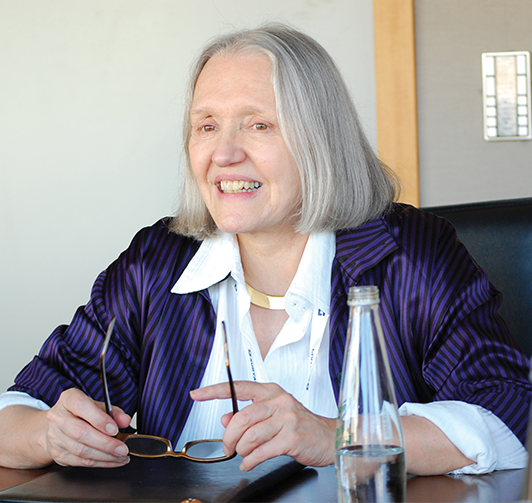
This presentation from Saskia Sassen engages some of the commonly used markers to identify cities and their major transformations. I argue that the familiar terms of gentrification and density are not quite useful in capturing what is happening today in a growing number of cities worldwide. To take just this past year, from mid-2014 to mid 2015, over a trillion US dollars was invested in buying ‘significant’ properties in 100 major cities across the world.
These numbers include only properties priced at over $5million and exclude investments in urban development/new construction, which have also expanded rapidly. At the same time the modest middle and working classes –often the majority of urban residents– increasingly cannot afford to live in cities that may have been home to many generations. What does this trend tell us about cities in today’s global world?
Saskia Sassen is the Robert S. Lynd Professor of Sociology, and chairs the Committee on Global Thought, Columbia University (www.saskiasassen.com). She is a student of cities, immigration, and states in the world economy, with inequality, gendering and digitization – three key variables running though her work. Her new book is Expulsions: Brutality and complexity in the global economy, (Harvard University Press 2014; French translation with Gallimard 2015). Other recent books are Territory, Authority, Rights: From Medieval to Global Assemblages (Princeton University Press 2008; French with Demopolis 2010), A Sociology of Globalization (W.W.Norton 2007; French with Gallimard 2009) and The Global City (Princeton University Press 1991/2001; French with Descartes). Her books are translated into over 20 languages. She is the recipient of diverse awards and mentions, ranging from multiple doctor honoris causa to being selected as a top global thinker for various lists. Most recently she was awarded the Principe de Asturias Prize in the Social Sciences, made a member of the Royal Academy of the Sciences of the Netherlands, and made a Chevalier de l’Ordre des Arts et Lettres by the French government.
Workshops
Review Workshop
Tuesday, July 4 | Room 1307
10:20 am – 11:20 am
Chair: Christine Cooper
Panel members: Jane Andrew, David Cooper
For the vast majority of academics, reviewing, like many of their tasks, is something “learned on the job”. There is scant, if any, formal training on how to be a reviewer. Moreover, academics in 2017 have to exhibit many of the characteristics of neo-liberal entrepreneurial subjects. Aside from possessing the skills of traditional scientists (theoretical understanding, research skills, thirst for knowledge, drive and so on), we now have to have business skills (creating value for grant awarding bodies, serving our customers and so on). In addition, many of us are subject to the constant tyranny of performance metrics. In short, the burdens which academics carry and the pressures placed upon them are overwhelming. In this setting, it isn’t surprising that the “gift economy” of reviewing is under extreme pressure. The purpose of this session is to discuss these and other issues connected to the review process.
Big Data & Critical Accounting Research Workshops
Wednesday, July 5 | Room 3323
08:30 am – 09:50 am
11:25 am – 12:45 pm
02:15 pm – 03:35 pm
Chair: Dean Neu
Panel members: See the detailed program.
These series of sessions focus on how critical accounting scholarship can utilize Big Data to analyze accounting topics that have public interest implications. The intertwined emergence of large data sets and methods to construct and analyze such data have changed social science practices and have created new possibilities and new challenges for critical accounting scholarship. These sessions both illustrate and critically reflect on the public interest research possibilities and limitations associated with Big Data.
Social Events
July 2, 2017: Early Bird Reception and Registration
Observatoire de la Capitale, 31st floor of the Marie-Guyart Building
Time: 6:30 pm
The Early Bird Reception of the conference will be held at 6:30 pm in the Observatoire de la Capitale. Join us for this cocktail reception and enjoy the spectacular views on the Old City, the majestic St. Lawrence River and the Laurentians.
Note that you are welcome to register during the Early Bird Reception, so that you can get your bus pass to commute to the university.
Observatoire de la Capitale
1037, rue de La Chevrotière, Québec, G1R 5E9
July 3, 2017: Elsevier Welcome Reception
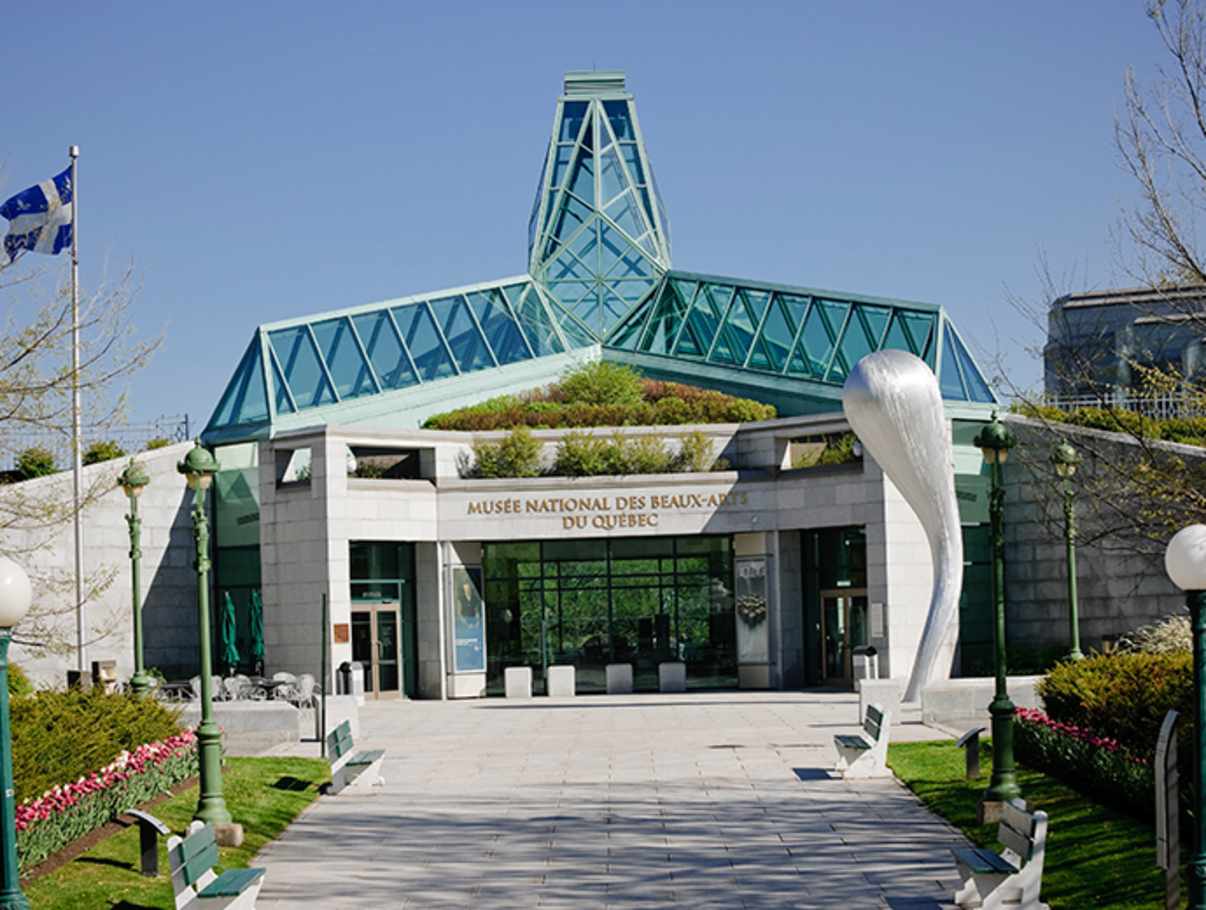

Central Pavilion of the Musée National des Beaux-Arts du Québec (MNBAQ)
Time: 6:30 pm
Elsevier will host our welcome reception at the Musée National des Beaux-Arts du Québec (MNBAQ). Join us at 6:30 at the MNBAQ Restaurant, in the central pavilion of the museum and discover David Altmejd’s masterful work The Flux and the Puddle.
The Musée National des Beaux-Arts du Québec (MNBAQ)
179, Grande Allée Ouest, Québec, G1R 2H1
July 4, 2017: Gala Dinner
Graduation Hall (Salle des Promotions) of the Quebec Seminary
Time: 6:30 pm
Our Gala Dinner will be held in the magnificent Graduation Hall (Salle des Promotions) of the Quebec Seminary, in the heart of the Old City. Enjoy the walk through the Old City and join us for pre-dinner drinks at 6.30 pm. Dinner will be served at 7:00 pm.
Université Laval was founded in 1852, with roots in the founding of the Quebec Seminary in 1663, making it the oldest centre of higher education in Canada and the first North American institution to offer higher education in French. Formerly used for official ceremonies to mark the life of the university, the Graduation Hall (Salle des Promotions) of the Quebec Seminary has transcended time and creates a lasting impression. The Graduation Hall is located within the central building of the Quebec Seminary, whose construction began in 1854. The building was recently renamed in honour of Camille Roy, an eminent rector of the university. The emblematic lanterns and mansard roof, designed by Joseph-Ferdinand Peachy and added in 1875, define its Second Empire style and celebrate the influence of French culture in the Americas.
Graduation Hall
20, rue Port-Dauphin, Ville de Québec, QC G1R 5K5
Practical Information
General information for the Conference
Download the general information in pdf | Download the Québec City map in pdf
Registration and Information Desk
You are welcome to register during the Early Bird Reception at the Observatoire de la capitale (see “Social Events”) on Sunday evening, in order to obtain your bus pass to commute to the University on Monday morning.
From Monday onwards, the conference registration desk will be located in the atrium of FSA ULaval in the Palasis-Prince Building. On Monday, registration will open at 7:30 am. The information/registration desk will be staffed throughout conference hours for queries and late registrations.
Information: Presenters & Discussants
- Discussants can access the paper they will review on the online submission system.
- Please arrive at your session room no less than 10 minutes prior to the start of the session. This will give you an opportunity to introduce yourself and upload on the room’s computer any file you would like to use.
- Please do not take more than 15 minutes to present your paper.
- The discussant of the paper will have 10 minutes to present her/his comments. This will be followed by a 15-minutes Q&A with the audience.
- Roaming audiovisual technicians will be onsite to assist you in addressing any technical problem encountered. Presentations must be provided on a USB memory stick, with the file in a PowerPoint PC format.
- These are self-chairing parallel sessions.
- Please designate a chair upon arrival to manage time and discussion during the session. Yellow (5 minutes) and red (1 minute) cards will be available in front of the room to signal remaining time.
Conference Hotline
For any questions or problems, please contact our conference hotline at 1-418-656-2131 ext. 6655 or dial 6655 from any phone in the building.
Internet Connectivity
A free WI-FI network is available on the campus. Name: Wi-Fi_UL.
Certificates of attendance
Please ask at the registration desk if you require a Certificate of attendance.
Breakfasts, Coffee Breaks and Lunches
Breakfast will be served at the Conference’s site from 7:30 am to 8:30 am every morning. Breakfasts and Coffee Breaks will be held at the Atrium of the Palasis-Prince building. Lunches will be held at the (indoor) Terrasse FIÉSA of the building.
Conference location
Apart from the evening social events, all conference activities will be held at the Faculty of Business Administration of Université Laval (FSA ULaval), in the Palasis-Prince Building, 2325, rue de la Terrasse, Québec City.
The University is located about 6 km from the city center and is easily accessible by public transportation. We do not advise walking to the University, unless you are staying in a hotel within the Ste-Foy district boundaries.
Public Transport pass
When registering, you will receive an unlimited pass for the Réseau de transport de la Capitale (RTC), Québec City’s public transit system, to get around the city during the length of the conference.
If you plan on registering on Monday morning, July 3, and take the bus from your hotel to the University, the ride will cost $3.50 (exact cash only). Otherwise, use the RTC card received when registering on Sunday night at the Early Bird Reception.
From Hotel Château Laurier and Hotel Delta to the University
You will find below the bus schedules and detailed itineraries (30 minutes) from Hotel Château Laurier and from Hotel Delta.
- Take the Metrobus 800 or 801 heading to Pointe-de-Sainte-Foy using the ‘Colline parlementaire’ stop (#1517) on René-Lévesque Est / Jean-Jacques-Bertrand, in front of the Congress Center. Metrobus stops are marked as Québec City map (click to download pdf). Metrobuses 800 and 801 run every 5 to 10 minutes.
- Get off at the Station Université Laval stop (#20580) at the intersection of Rue de l’Université and Avenue des Sciences Humaines.
- Head northeast on Rue de l’Université and turn left onto Avenue du Séminaire.
- Walk up Avenue du Séminaire until Pavillon Palasis-Prince, the last building on the left, at the crossing with Rue de la Terrasse.
Time: 6:30 pm
Observatoire de la Capitale, 31st floor of the Marie-Guyart Building
1037, rue de La Chevrotière, Québec City
Join us for this cocktail reception at the Observatoire and enjoy the spectacular views on the Old City, the majestic St. Lawrence River and the Laurentians. Note that you are welcome to register during the Early Bird Reception, in order to obtain your bus pass to commute to the university.
Walking Directions: From Hotels Chateau-Laurier and Delta Québec, the Observatoire de la Capitale is just a few blocks away. You will find it on your Québec City map (click to download pdf) (Number 31, C4) or Google Maps. If you are coming from another area of the city, the closest 800-801 bus stop is “Colline Parlementaire”, in front of the Congress Center, on René-Lévesque East Boulevard.
July 3, 2017: Elsevier Welcome Reception
Time: 6:30 pm Central Pavilion of the Musée National des Beaux-Arts du Québec (MNBAQ) 179, Grande Allée Ouest, Québec City
Elsevier will host our welcome reception. Join us at 18:30 at the Musée National des Beaux-Arts du Québec (MNBAQ) Restaurant, in the Central Pavilion of the museum and discover David Altmejd’s masterful work The Flux and the Puddle.
Walking Directions: You will find the MNBAQ on your Québec City map (click to download pdf) (Number 29, A5) or Google Maps. If you are coming directly from the University, the closest 800-801 bus stop is “Cartier” (on René-Lévesque Ouest Boulevard / Cartier Avenue). From Hotels Chateau-Laurier and Delta Québec, it is a 15-minute walk along trendy Grande Allée. You can access the Central Pavilion either by going through the Pierre Lassonde Pavilion, on 179 Grande Allée Ouest, or directly by walking down Wolfe Montcalm Avenue.
Time: 6:30 pm Quebec Seminary (Séminaire de Québec) Graduation Hall (Salle des Promotions) 20, rue Port-Dauphin, Québec City
Our Gala Dinner will be held in the magnificent Graduation Hall (Salle des Promotions) of the Québec Seminary, in the heart of the Old City. Enjoy the walk through the Old City and join us for pre-dinner drinks at 6:30 pm. Dinner will be served at 7:00 pm.
Walking Directions: You will find the Québec Seminary on your Québec City map (click to download pdf) (F4, Séminaire de Québec) or Google Maps. Enter the Québec Seminary through the main door, at 20 rue Port-Dauphin. Cross the parking lot and you will easily find the Graduation Hall, on the 4th floor of the Camille-Roy building. From Hotels Chateau-Laurier and Delta Québec, it is a 15 to 20-minute walk through the heart of the old city. Make sure not to forget your map! If you want to avoid walking, the best alternative is to take a taxi since the 800-801 will leave you at the entrance of the Old City (“Place d’Youville” bus stop, on Honoré-Mercier Avenue). See below for telephone number of taxi services.
Jean Lesage International Airport (YQB) is just 20 minutes away from downtown Québec City. At the airport, taxi services are within easy reach to access downtown (Fixed rates: $34.25 CAN. Cash or credit cards are accepted).
If you wish to share a taxi with other delegates on your way back to the airport, sharing request forms will be available at the information desk during the conference.
If you need a taxi, you can call one of the following numbers:
Taxi Coop Québec: 418 525-5191
Taxi Coop Sainte-Foy–Sillery: 418 653-7777
Taxi Laurier: 418 651-2727
Numerous restaurants are located in the hotels’ area, either on Grande Allée or within the Old City.
Here is a list of suggestions. (PDF)
Note that tip and sales taxes are usually not included in the prices disclosed on menus. Typically, waiters expect to have a 15% tip.
The average maximum temperature in Québec City at the beginning of July is 24°C. During the night, expect an average temperature of 14°C. That being said, variability can be quite high. It is not unusual to get a maximum temperature, in July, that oscillates between 15°C and 30°C. The likelihood of rainy days is probably around 35%. Bringing an umbrella may therefore be useful.
Other information
New entry requirements are now in effect in Canada. All foreigners except U.S. citizens are now expected to have either an Electronic Travel Authorization (eTA) or a visitor visa to enter Canada.
Be prepared:
- Find out if you need an eTA or a visa
- If you need an eTA (EU citizens, for example): Apply for an eTA before you book your flight to Canada. Most applicants get approved within minutes. However, some applications can take several days to process so don’t wait until the last minute.
- If you need a visitor VISA, note that a VISA application may take several weeks or months to process. Even though we will render our conference selection decisions on February 28, 2017, we recommend that you file your VISA application as soon as possible, online, through Immigration, Refugees and Citizenship Canada’s website. To do so, you will have to enclose, with your application, a letter of invitation from the organizers of the 2017 CPA Conference. To obtain this letter, you must:
- Register to the Conference and pay all conference participation fees
- Send an email request to evenements@fsa.ulaval.ca
- Don’t delay!
Important flight information
Please note: Specifically, Université Laval is located in Québec City – NOT in the City of Laval (which is close to Montréal).
People flying to the Conference need to ensure that their final destination is Québec City – Jean-Lesage International Airport – YQB. Québec City is located about 250 kilometers (155 miles) away from Montréal.
By plane
Jean-Lesage International Airport, 16 km (10 miles) away from downtown Québec City, can be reached via boulevard Wilfrid-Hamel (138) or autoroute Duplessis (540).
Phone: 418-640-3300 or 1-877-769-2700
Direct flights from many major cities in Canada, Eastern US, and Europe are provided to Québec City such as Montreal, Ottawa, Toronto, New York, Chicago and Paris.
For all flight options from and to Québec City, please refer to the list of destinations served by Québec City Jean Lesage International Airport or the Air Accessibility Chart.
By car
Highway 20 (autouroute Jean-Lesage) runs along the south shore of the St. Lawrence River, and Highway 40 (autoroute Félix-Leclerc) is the north shore access to the city.
By bus
Fédération des transporteurs par autobus – Intercity Transit
Accessible to all, the intercity transportation network consists of 222 bus stations throughout Quebec for efficient, timely travel.
Intercar
Intercar links Québec City with Saguenay, Lac-Saint-Jean, Charlevoix, and all destinations along the North Shore (Côte-Nord).
Orléans Express
Orléans Express Coach Lines provide daily service between Québec City, Montréal, and other destinations in the province.
Greyhound
Visitors travelling by bus from the USA come into Montréal via Greyhound, then transfer to Orléans Express bus for Québec City.
Québec City Bus Stations
Gare du Palais Bus Terminal
320, rue Abraham-Martin, Québec
418-525-3000
Sainte-Foy Terminal
3001, chemin des Quatre-Bourgeois, borough of Sainte-Foy–Sillery–Cap-Rouge
418-650-0087
By train
VIA Rail Canada Daily VIA Rail Canada service between Toronto, Ottawa, Montréal and Québec City.
Phone: 1-888-842-7245
Visitors traveling by train from the USA come into Montréal via Amtrak, then transfer to VIA Rail Canada trains for Québec City.
Amtrak
Phone: 1-800-USA-RAIL (1-800-872-7245)
Québec City Train Stations
Gare du Palais (Central Station)
450, rue de la Gare-du-Palais, Québec
1-888-842-7245
Gare de Sainte-Foy
3255, chemin de la Gare, borough of Sainte-Foy–Sillery–Cap-Rouge
1-888-842-7245
Breakfast
We would like to remind participants that breakfast will be served at the Conference’s site, i.e. Faculté des sciences de l’administration of Université Laval).
Hotels with special room rates
The conference organization have secured special room rates in two hotels in the city center of Québec City for the duration of the 2017 CPA Conference. Both hotels are located nearby the bus station “Colline Parlementaire”, from where you can take the public transportation buses that will allow you to commute to the university (bus 800 or 801). Please note that the Organizing Committee is not interfering in the hotel bookings.
Hôtel Chateau Laurier
Located on trendy Grande Allée, 5 kilometres east of Université Laval, Hôtel Château Laurier is right in the heart of Old Québec, a few minutes’ walk from many restaurants and tourist attractions, and a stone’s throw from the Plains of Abraham.
Hôtel Chateau Laurier
1220, Place George-V Ouest
Québec (Québec), G1R 5B8
Website
Accommodation costs is not included in the registration fee. Preferred room rate starts at $149 CAN per night plus taxes. Use the confirmation number 17373 when making reservations. Hôtel Chateau Laurier must be contacted no later than June 2, 2017 to receive the group discount room rate. Rooms are based on availability and may sell out prior to the cut-off date.
- 1 800 463-4453 or reservation@vieuxquebec.com
Delta Quebec
Located downtown, in the heart of the city’s Old Town district, Hotel Delta Québec is just moments from a wide range of notable attractions. Restaurant and Bar Le Bistro, fitness centre and heated outdoor pool open year-round.
 Photo: Delta Quebec
Hôtel Delta Québec
690, boulevard René-Lévesque Est
Québec (Québec) G1R 5A8
Website
Accommodation costs is not included in the registration fee. Preferred room rate starts at $169 CAN per night plus taxes. Use the confirmation number 22997 – C5F when making reservations. Hôtel Delta Québec must be contacted no later than June 2, 2017 to receive the group discount room rate. Rooms are based on availability and may sell out prior to the cut-off date.
- 1 800 268-1133 or Que.reservations.sm@deltahotels.com or make your reservation online
Other Hotels available
Many hotels and other types of accommodations are found in Québec City. No matter what your decision is, please make sure not to be located too far away from the public transportation buses that will allow you to commute to the university (bus 800 or 801).
Hotels near the Old City
The area near the Old City where the two hotels that we recommend are located includes many other options in terms of accommodation. Here are some possibilities:
Please note: No preferential rates have been negotiated with these hotels.
Hotels in the Old City
Those of you who like to walk, then staying in the Old City (Vieux Québec) is an option; if so, expect to walk between 1 or 2 kilometers in order to take bus 800 or 801 to the University. Here is one option – but many other options can be found:
Please note: No preferential rates have been negotiated with these hotels.
Hotels near the conference site (Université Laval)
Less expensive hotels can be found around the conference site (i.e., Université Laval) – although the decorum is less spectacular than closer to the Old City. From the University, it is easy to take bus 800 or 801 in order to go to the Old City area, where the social events will take place during the evenings. Here are some options:
Please note: No preferential rates have been negotiated with these hotels.
Student Residences of Université Laval
Located on the Université Laval campus, Students Residences of Université Laval offer a convenient and affordable alternative for participants.
Student Residences of Université Laval
2255, rue de l’Université
Québec (Québec) G1V 0A7
Website
Accommodation cost is not included in the registration fee. Preferred Residence room rate starts at $47,50 CAN per night plus taxes in single occupancy and $67 plus taxes in double occupancy, breakfast included. Use the confirmation code CPA 2017- event #267057 when making reservations.
Standard University Room (shared bathroom)
These rooms have two single beds and feature all the amenities usually available in hotels or bed linen and towels, shampoo and soap, parking included, free wireless internet access and free local calls.
Rates: $47,50 + taxes in single occupancy and $67 + taxes in double occupancy (*Breakfast is include)
Superior University Room (private bathroom) (available year round)
These rooms are equipped with a bathroom, a Queens bed, a TV, a microwave oven, refrigerator and telephone. They usually have all the amenities offered by hotels or bed linen and towels, shampoo and soap, parking included, free wireless internet access and free local calls.
Rates: $88 + taxes in single occupancy or double occupancy (*Breakfast is include)
- 418-656-5632 or hebergement@sres.ulaval.ca
From Students Residences to FSA ULaval (walking distance)

Tourist advice from the Conference organizers
The Province of Québec and beyond
Québec City, by itself, is certainly worth a stay of three or four nights. In addition, the Province of Québec is a fascinating area to visit. If you are interested in exploring the Province beyond Québec City and Montréal, then you will discover very nice landscape, villages and people. You will have to rent a car, however. Here are a number of itineraries.
Québec City
An authentic experience!

Québec City, a UNESCO World Heritage Treasure is surrounded by gorgeous landscapes. Historical, cultural and outdoor activities, exquisite food as well as international events await. Old Québec and nature splendours, just minutes from town, are sumptuous in every season!
City Districts
Québec City’s different districts reflect the lifestyles of their residents. They’ll be happy to share some local secrets with you! Here are a few neighborhoods to discover:
- Old Québec
- Petit-Champlain
- Place-Royale and Old Port
- Parliament Hill
- Saint-Jean
- Saint-Roch
- Old Limoilou
- Charlesbourg Heritage Site
- Sillery Heritage Site

Landmarks
Don’t miss Québec City’s most distinctive features:
Welcome to Québec City!
This text is taken from the Québec City Tourism website.
To Discover
“Charlevoix” and the South shore
Charlevoix (North shore of the St-Lawrence river) is really worth seeing. It is about a 2-hour drive (route 138) from Québec City. It is certainly worth stopping at Baie St-Paul and sleeping for one or two nights at La Malbaie (suggestion: in Manoir Richelieu). There are then three alternatives:
1. Getting back to Québec City on the same road.
2. Another suggestion is to take the ferry from Saint-Siméon to Rivière-du-Loup. Rivière-du-Loup (South shore of St-Lawrence river) is one of the areas in the world with the most beautiful sunsets (seriously). Possibilities of whale watching tours. It is worth sleeping there for a night or two. When getting back to Québec City on highway 20, make sure to stop in Kamouraska.
3. A third suggestion is to continue on route 138 to Tadoussac and sleep for one night there. Possibilities of whale watching tours. Then head to Forestville and take a ferry to Rimouski (South shore of St-Lawrence river). You may stay in Rimouski for a few nights (very nice sunsets). Make sure to visit the Parc du Bic as well as the Jardins de Métis – and the “Doors to Hell” (Portes de l’Enfer). Then get back to Québec City on highway 20/route 132. Rimouski is Yves’ hometown.
Gaspé Peninsula
One of the nicest tourist itineraries is the “tour de la Gaspésie” (Gaspé Peninsula). Take highway 20 then route 132. Then plan to sleep for two nights in Rimouski, then two nights at the Gîte du Mont-Albert (near Ste-Anne-des-Monts); two nights in Gaspé (Parc Forillon); two nights in Percé (the scenary there is just gorgeous; make sure to take the boat tour to Ile Bonaventure); two nights in Carleton; then two nights in Rivière-du-Loup.
Beyond the Province of Québec
The Thousand-Island area in Eastern Ontario is a recognized tourist area. To get there, you first need to go to Montréal (this is a very lively city; you may want to spend some days there) and then continue for about 2.5 hours on highway 401 towards Toronto.
Another nice area to visit is the Maritime provinces. One nice and relaxing town is Shédiac, New-Brunswick. It takes about 8 hours to get there from Québec City. Once there, you are very close to Prince-Edward Island. Cape Breton is also not that far away.
Useful links

Faculty of Business Administration (FSA ULaval)
Since 1924, FSA ULaval has been training students to become competent and responsible managers and business specialists. Today, FSA ULaval is part of a select group of 80 Business Schools, out of more than 12000 worldwide, to have obtained both the AACSB and EQUIS accreditations.
- Approximately 4,300 students, including more than 700 international students
- More than 125 professors and full-time lecturers ready to engage with students and whose research expertise is internationally renowned
- A dynamic network of more than 35,000 graduates in 52 alumni clubs in Canada and abroad
- Close connections with large international corporations and local SMEs
- State-of-the-art technological infrastructure
- A Canadian leader in hybrid and online-based education
- Partnerships with some 90 world-renowned universities and management schools
- 20 world-class research chairs, centres and laboratories
- Outstanding student-athletes within our competitive Rouge et Or sports teams
- A vibrant student life with more than 20 student organizations
- A very high graduate satisfaction rate
Université Laval
- A well-rounded university
- More than 399 programs
- Renowned mobility and exchange programs
- Three profiles : sustainable development, entrepreneurial, and international
- Custom, continuing, and distance education programs
- Some 700 partnership agreements with some 500 universities in nearly 70 countries
- A library of over 6 millions documents
- A vibrant and diverse community
- Some 48,000 students
- Nearly 4,600 international students
- Nearly 270,000 graduates since the university’s founding
- More than 2,700 regular faculty and lecturers
- Over 250 student associations
Contact Us

Contact information
Main conference: CPA2017@fsa.ulaval.ca
Emerging Scholar Colloquium: Marion.Brivot@fsa.ulaval.ca
Emerging Scholars Colloquium (ESC)
Emerging Scholars Colloquium: July 2, 2017
FSA ULaval
Ville de Québec, Canada
The Emerging Scholars’ Colloquium (ESC) precedes the main CPA 2017 conference. Emerging scholars who have just completed their PhD (in 2016 or in 2017, prior to the Conference) or who are currently completing a PhD – not in their first year – on political, social, environmental or organizational aspects of accounting are welcome to submit an application form.
The ESC program is now available.
Due to many requests received, we have decided to simplify the submission process. You no longer need to send a recommendation letter. Please use the shorter application form attached below. If you have already filled out the previous (longer) version of the application form, that is fine too.
Please fill out the Application Form and send it with a résumé, and the working paper or the thesis chapter that you wish to present to Marion Brivot at marion.brivot@fsa.ulaval.ca.
The submission deadline is February 10th, 2017. Notification of acceptance or otherwise will be sent in February 2017. Please do not submit the same paper to the main conference and to the ESC. You may, however, submit two different papers to both events.
Please note that, in some countries, applying for a visa to come to Canada may take several months. We strongly advise you to plan ahead for this. Unfortunately, we do not have the resources to provide assistance in this process but we can send an official letter, once your application has been accepted, with the date and place of the colloquium.
PhD students:
- Colloquium: $115
- Colloquium + conference: $505
Early scholars (who defended their thesis in 2016 and in 2017, prior to the Conference):
- Colloquium: $115
- Colloquium + regular registration to the conference: $895 ($115 + $780)
- Includes: registration fee, lunch, beverages and snacks during the colloquium’s coffee breaks.
The colloquium is aimed at providing emerging scholars with the opportunity to present their work to peers and established accounting scholars for constructive feedback and advice. The ESC is organized by Marion Brivot (Université Laval) and brings together a team of faculty members from around the world, including the following professors who have tentatively accepted to participate:
- Marcia Annisette, York University, Toronto, Canada
- Judy Brown, Victoria University of Wellington, Wellington, New Zealand
- Bino Catasús, Stockholm University, Stockholm, Sweden
- Christine Cooper, University of Strathclyde, Glasgow, UK
- Yves Gendron, Université Laval, Québec City, Canada
- Darlene Himick, University of Ottawa, Ottawa, Canada
- Lee Parker, RMIT, Melbourne, Australia
- Mike Power, LSE, London, UK
- Michelle Rodrigue, Université Laval, Québec City, Canada
Important notice concerning entry requirement in Canada
New entry requirement are now in effect in Canada. All foreigners except U.S. citizens are now expected to have either an Electronic Travel Authorization (eTA) or a visitor visa to enter Canada. For more information, see Practical Information.
Forthcoming Events
The 2018 Alternative Accounts Conference organizing committee of HEC Montréal invites you to join us in Canada’s dynamic university city for next year’s national conference.
The Alternative Accounts Conference brings together accounting faculty and doctoral students from North America and beyond who are interested in alternative accounting research. The Conference especially aims to increase accounting researchers’ awareness of the diverse areas of research belonging to the “alternative” paradigm of accounting research, and to provide a forum to discuss these studies from a variety of viewpoints – in a constructive environment. It rotates between Alberta, Ontario and Québec.
Alternative Accounts Conference 2018 website
2018 IPA conference
The 12th Interdisciplinary Perspectives in Accounting Conference (IPA) will be held in Edinburgh University Business School on 11-13 July 2018. An emerging scholars colloquium will precede the main conference.
The IPA is a major forum for accounting researchers with broad social science interests and those operating in a diverse range of other disciplines with an interest in accounting. The conference has an established reputation for raising issues about the way that accounting affects, and is affected by, its social, political and economic environments.
2019 APIRA conference
The 9th Interdisciplinary Research in Accounting (APIRA) Conference will be held in Auckland University of Technology (AUT), New Zealand on 1-3 July 2019 and the Emerging Scholars’ Colloquium on 30 June 2019.
The APIRA conference provides an international forum and showcase for research on the social, political, and institutional aspects of accounting theory and practice. It fosters and supports interdisciplinary research in accounting. The APIRA conference is held in association with the Accounting, Auditing & Accountability Journal (AAAJ).
2020 CPA conference
We are pleased to announce that the 2020 Critical Perspectives on Accounting (CPA) Conference will be held at the Schulich School of Business, York University, Toronto, Canada. Like its sister conferences, the IPA and APIRA, the conference will be held in July so as to avoid most teaching scheduling conflicts. An emerging Scholar’s Colloquium will precede the main conference.
The CPA Conference is an established forum for critical, radical and other interdisciplinary approaches to the study of accounting phenomena. It brings together scholars in the fields of accounting, management and the broader social science disciplines who are concerned to illustrate how deeply implicated accounting is in the allocative, social, and ecological problems of our times. As well, it attracts practitioners, policy makers and activists who are interested in these pressing issues and committed to social change.
AAAJ Special Issue on “Accounting and Accountability changes in Knowledge Intensive Public Organisations”

Eco-Responsible Event
This event respects measures that are part of our commitment to pursuing sustainable development. In this sense, we recommend using public transit or carpooling. It is also possible to offer voluntary compensation for greenhouse gas emissions.