
Research Chair in Statistical Learning
The goal of the Chair is to develop statistical learning methods for complex data in the biomedical and social sciences.
The Chair is focused on functional data, i.e., data that varies over a continuum and can be represented as curves or surfaces.
Chair holder
Marzia Angela Cremona
Associate Professor
Chair awarded by IVADO with the support of the FRQ

Why create this Chair?
Professionals in the biomedical and social sciences work more and more often with data that varies over a continuum and can be represented as curves or surfaces. Take for example “omics” (such as high-resolution data measuring the genome), longitudinal data (such as continuously measured blood glucose levels), or data on stock prices over the course of a day.
Functional data like this is intrinsically infinite, which poses a major challenge for robust, reliable analysis and effective, scalable calculations.
While more and more is being published on functional data analysis methods and applications, many machine learning (ML) tools cannot yet generalize to functional data and there are still very few effective, user-friendly programs for non-statisticians.
-
Cap sur l’avenir – Océans, vie et navigation durable
Friday, July 24, 2026
-
Geoinformatics and geospatial data analysis for extremeevents and climate change related vulnerabilities
Wednesday, December 10, 2025
-
Symposium en apprentissage statistique pour les données complexes
Tuesday, November 25, 2025
Four major research areas
The Chair’s research program is built around four major research areas, selected to expand the scope of application of functional data analysis methods in the biomedical and social sciences.
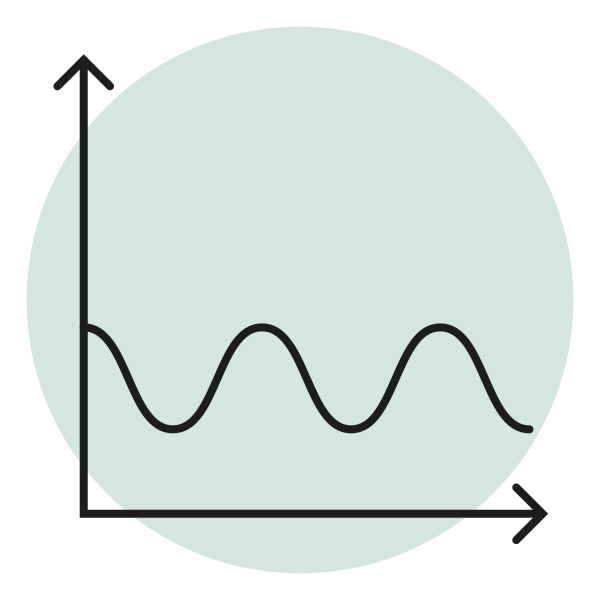
Area 1
Developing unsupervised learning methods for functional data
Area 1 tackles problems with unsupervised learning related to functional pattern discovery (i.e., repeated forms) and dimensionality reduction in a set of curves.
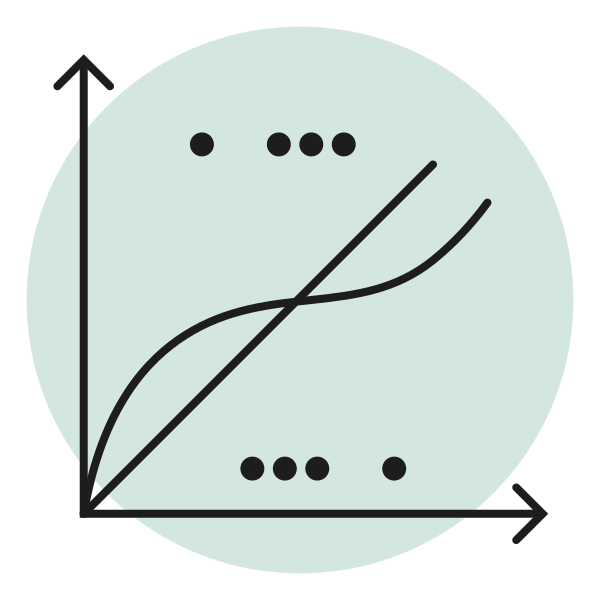
Area 2
Developing supervised learning methods for functional data
Area 2 looks at the different aspects of linear and logistic regression models, in cases where the independent or dependent variables are functional data.

Area 3
Applying AI methods to biomedical science
Area 3 aims to leverage a combination of artificial intelligence (AI), ML and statistical methods to analyze complex, functional and other types of biomedical data. This area will specifically focus on “omics” (such as high-resolution data measuring the genome) and high-resolution longitudinal data related to type 1 diabetes.

Area 4
Applying AI methods to the social sciences
Area 4 aims to employ various AI techniques, specifically ML, to analyze financial and environmental science data.
Goals of the Chair
- Develop new statistical/machine learning methods for functional data that combine statistics and computing to produce user-friendly, computationally efficient tools, built on strong statistical foundations for greater reasoning.
- Address questions related to robust statistics, interpretability and possible biases in the methodologies developed.
- Generalize and adapt these and other AI methods, so they can be easily applied to analyze different data in the biomedical and social sciences.
- Promote functional data analysis techniques in the AI community, to attract more researchers in the field to leverage functional data analysis ideas in their tools and analyses.
Impact of the Chair
The Chair will broaden the scope of application of functional data analysis techniques in AI to produce methods with a strong statistical foundation that can extract relevant information from functional data across multiple fields.
The Chair will also train highly qualified experts in statistical learning and data analysis by offering multi-disciplinary, collaborative, global education opportunities.
Contact us
Department of Operations and Decision Systems
Pavillon Palasis-Prince, local 2449
2335, rue de la Terrasse
Université Laval
Québec (Québec) G1V 0A6
Chairholder
Marzia Angela Cremona