
Séminaire du Fonds Conrad-Leblanc
Date 14 avril 2023
Heure 9h15 à 12h HAE
Lieu Salle Power Corporation du Canada (3452)
Événement gratuit
À propos de
l'événement
Dans le cadre des activités du Fonds Conrad-Leblanc, nous vous convions à un séminaire qui met en vedette deux conférenciers de grande notoriété: Ruey S. Tsay, Ph. D. (Wisconsin), et Jianqing Fan, Ph. D. (Berkeley).
Ce séminaire est organisé en partenariat avec le Département de finance, assurance et immobilier de l’Université Laval, la Chaire d’actuariat de l’Université Laval et les salles des marchés Carmand-Normand et Jean-Turmel de l’Université Laval, et appuyé par les partenaires de diffusion CFA Québec, Quantact, le Club des Actuaires de Québec et le Cercle finance du Québec .
Le séminaire sera présenté en anglais. L’inscription est gratuite, mais obligatoire. Café et viennoiseries seront offertes à compter de 8h45.
Ne manquez pas cet événement de prestige!
Conférences
AI, Big Data, Statistics, and the Future
Par Ruey S. Tsay, Ph.D. (Wisconsin)
Artificial Intelligence (AI, or Deep Learning) and big data have attracted great attention in recent years. The availability of big data and advancements in computation methods and capability further accelerate the development in machine learning. There is no doubt that AI will affect every aspect of our life in the future. In this talk, we discuss the following issues: (a) What is AI? (b) What is machine learning? (c) What roles can data play in the development of AI? (d) How important is statistics in Deep Learning? And (e) How to prepare for the AI challenges? The talk will emphasize on the statistical view on the value of data and the importance of statistical reasoning and methods in the development of smart AI.
Structural Deep Learning in Financial Asset Pricing
Par Jianqing Fan, Ph.D. (Berkeley)
We first give an overview on the genesis of machine learning and artificial intelligence (AI) and how statistical and computational methods have evolved with growing dimensionality and sample sizes and become the foundation of modern machine learning and AI. Then, we develop new financial economics theory guided structural nonparametric methods for estimating conditional asset pricing models using deep neural networks, by employing time-varying conditional information on alphas and betas carried by firm-specific characteristics. Contrary to many applications of neural networks in economics, we can open the “black box” of machine learning predictions by incorporating financial economics theory into the learning, and provide an economic interpretation of the successful predictions obtained from neural networks, by decomposing the neural predictors as risk-related and mispricing components. Our estimation method starts with period-by-period cross-sectional deep learning, followed by local PCAs to capture time-varying features such as latent factors of the model. We formally establish the asymptotic theory of the structural deep-learning estimators, which apply to both in-sample fit and out-of-sample predictions. We also illustrate the “double-descent-risk” phenomena associated with over-parametrized predictions, which justifies the use of over-fitting machine learning methods. (Joint with Tracy Ke, Yuan Liao, and Andreas Neuhierl)
Conférenciers
-
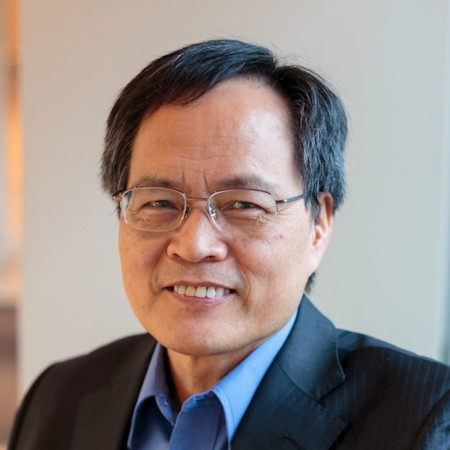
Ruey S. Tsay, Ph.D.
H.G.B. Alexander Professor of Econometrics and Statistics
The University of Chicago Booth School of Business -
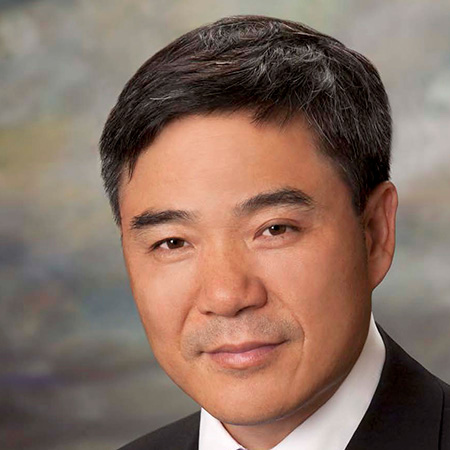
Jianqing Fan, Ph.D.
Frederick L. Moore '18 Professor of Finance, Professor of Statistics, and
Professor of Operations Research and Financial Engineering
Princeton University