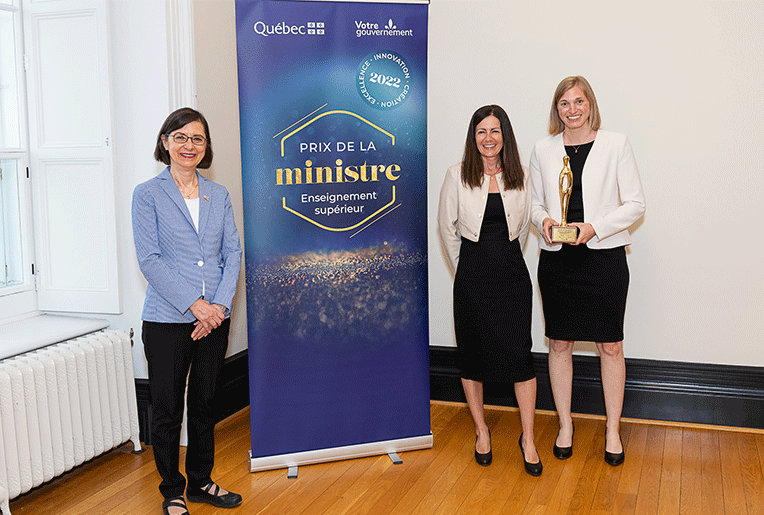
Awards for an Ethics Education Program Developed by 2 FSA ULaval Professors
Thursday May 26th, 2022
The issue of ethics is a difficult one to address in the context of university education. Not only are there many factors that come into play in these types of complex decisions, but professional and personal experience are also extremely important elements to incorporate. Applying the theoretical concepts learned in the classroom to realistic situations is essential to developing the “ethical muscle.” It is with this need in mind that FSA ULaval professors Cynthia Courtois and Claire-France Picard have designed a tool that is the only one of its kind. It is so unique that it has recently won two awards from the education community.
Two Awards for Innovation
The first award bestowed upon Professors Courtois and Picard is the Prix de la ministre en Enseignement supérieur. This award, which is given out every two years, highlights the inventiveness and engagement of college and university faculty members in three component areas:
- Educational Resources
- Distance Learning
- Recognition of Teaching Excellence
As such, the professors’ ethical reflection tool was recognized in the Complementary Didactic Resources category of the Educational Resources component.
The second honour was awarded by The Canadian Academic Accounting Association (CAAA). The professors’ ethics education tool received the Howard Teall Award for Innovation in Accounting Education. This award recognizes dedication to creating original learning activities and encouraging students to pursue future learning opportunities through unique accounting education methods.
The award committee mainly pointed out the different and innovative teaching approach put forward that makes it possible to address a complex issue – ethics – in a concrete, profound and sustainable manner.
How Does This Tool Work?
Looking at these awards, one may wonder what the tool consists of. Under the title “Beyond the Figures: Stimulating the Ethical Reflection of Tomorrow’s Accountants,” the project is composed of various media put together to stimulate thinking among students. To achieve this, it attempts to emotionally engage individuals in their learning through concrete simulations. With the help of technology, these simulations place learners as the core focus of their reflection process.
The participants first fill out a short questionnaire at the beginning of the semester in which they indicate their preferences in terms of work environment and roles. Based on this information, the individuals are assigned to a simulation that most closely fits the context of their goals, which helps enhance their immersion experience. Ten different pathways are available.
From that point forward, the students are included in a 5-part structure that takes place over 6 weeks. Each of these divisions includes a trigger, a decision to be made, a reaction and a follow-up in the form of a journal and feedback. Several of these triggers and reactions are in video format, which is also one of the special elements of the simulations.
To enhance the immersive effect and realism, the videos are presented from a first-person point of view, as seen through the eyes of the participants. In addition, the professors enlisted professional actors, and referred to real-life cases to create the ethical situations. Thus, the students see the individuals, make their decision and immediately see the reaction of their fictional boss. This reaction lets the students see the impact of their choice, which can be destabilizing for them. The students must then document their emotions, thoughts and the issues they anticipate in the journal, and repeat the process for the other parts as the situation continues to unfold.
Once all the parts have been completed, the participants produce a written report of the experience, and then engage in discussions with the other individuals who played a similar role in the simulation. These two actions bring personal experience and theory together in the same space, and provide an opportunity to test arguments in front of other people. The students also have an opportunity to learn firsthand from the perspectives of others and develop their critical thinking and ethical argumentative skills.
This process as a whole earned Professors Claire-France Picard and Cynthia Courtois these awards. The project’s implementation and deployment were supported by the Pedagogical and Technological Services team, and more specifically by Amélie Dubé, training advisor, and by Éric Demers, audiovisual production technician.
Congratulations on this ingenious tool that helps better prepare tomorrow’s accountants for their careers!
Last News
Published
-

Classe Affaires FSA ULaval: continuing business administration education’s new signature
Wednesday August 21st, 2024
-

A new management team at FSA ULaval
Tuesday July 2nd, 2024
-

Une grande conférence du 100e et une médaille Palasis-Prince pour Édouard Philippe
Wednesday May 15th, 2024
-

The Port Industry: FSA ULaval Partnerships in Overdrive
Wednesday May 15th, 2024
-

Décathlon Collects a Wealth of Ideas at Université Laval
Monday May 6th, 2024
-

A Second Term for Dean Frank Pons
Friday April 19th, 2024
-

COTE 100 Joins FSA ULaval in an Innovative Project on Long-Term Investment
Tuesday February 20th, 2024
-

Promoting FSA ULaval’s Seals of Excellence
Wednesday October 18th, 2023
-

New Specialized Graduate Degree (DESS) in Information Systems Auditing
Wednesday July 19th, 2023
-

FSA ULaval Renews Its Membership in the United Nations PRME Initiative
Wednesday July 5th, 2023
-

Université Laval’s Largest Faculty Graduation Ceremony to Celebrate Our Graduates’ Achievements
Thursday June 22nd, 2023
-

Professor Maurice Gosselin Receives Major Career Recognition From the CAAA
Thursday June 1st, 2023